Every year the CloudFest Hackathon puts a few dozen people in a room for three days and asks them to build something useful for the open-source web, for free, and give it away at the end. This year I went as one of the leads on a project called AI-Powered Plugin Builder for WordPress, together with my Hostinger colleagues Lada Makei and Martynas Umbražiūnas.
I have written a lot of plugins over the years, including one that has passed ten million downloads. So the problem we picked was one I have watched people run into for most of my career.
The problem we picked
If you run a WordPress site and need one specific piece of custom functionality, you have two bad options. You can hire a developer, which is the right answer for serious work but wildly disproportionate for a twenty-line tweak. Or you can install an all-in-one plugin that ships the feature you wanted along with eighty you did not, and slows your site down carrying them.
There are more than 60,000 plugins in the WordPress repository, which sounds like it should solve the problem and mostly does the opposite: finding the lightweight one that does exactly your thing is close to impossible.
AI was supposed to fix this, and it half did. You can ask a chatbot for the code. Then you copy it into an editor, zip it up, upload it, find out it does not activate, and go back to the chatbot. The generation got easy; the workflow stayed broken. That gap is what we wanted to close.
From a prompt to an installed plugin
The idea is deliberately unglamorous: describe what you want, in plain language, inside the WordPress admin — and get a working plugin, generated, installed and ready to activate. No IDE, no file transfers, no switching tabs.
Over the three days the team shipped rather more than the minimum:
- Plugins generated from natural-language prompts, with the site’s own context passed to the model
- An AI prompt-enhancement step, so users who are not sure how to phrase a request still get good results
- Conversation history and iteration, so a plugin can be refined across several sessions
- One-click installation and activation once the code is generated
- A downloadable ZIP, for anyone who wants to review or version-control the output
- Quality, security and compatibility checks via the Plugin Check plugin, with automatic fixes where possible
- Slug-collision detection, so a new plugin cannot quietly overwrite an existing one
- AI guidance on sensible next steps after a plugin is installed
- WordPress Playground support, so the whole flow can be tried without a live site
This is what it looks like in practice:
Built on WordPress 7.0’s AI foundations
The timing was the interesting part. We built on the new Connectors API arriving in WordPress 7.0, which gives a single interface to Anthropic, OpenAI and Gemini models, and on the PHP AI client SDK from the WordPress AI Building Blocks effort. Working against a beta of the platform for three days is not the most relaxing way to spend a hackathon, but it meant the result was built on where WordPress is actually going rather than on a workaround.
The model side is prompt-engineered around WordPress coding standards and security practices, because “it generated some PHP” and “it generated PHP you should let near a production site” are very different claims.
Eight people, eight countries
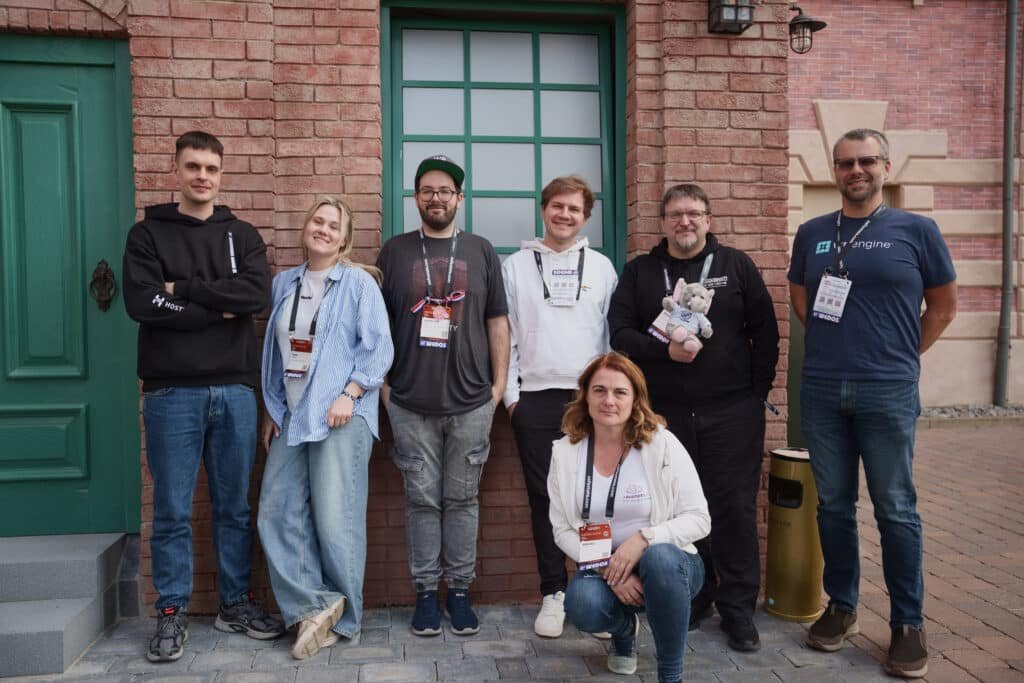
The team was eight contributors from Germany, Greece, Belarus, Italy, Lithuania, Austria, Switzerland and the United States — Justin Joe Kostka, Katia Tsironi, Lada Makei, myself, Martynas Umbražiūnas, Monika Pucher, Pascal Birchler and Weston Ruter, mentored by Lucas Radke. Several of us met for the first time at the hackathon itself.
This is the part that does not fit neatly into a project description. Eight people who have never worked together, in a shared language none of us grew up speaking, shipping something coherent in under three days, is a genuinely strange thing to watch happen. It works because everyone arrives having already agreed on what “good” looks like — the WordPress ecosystem does that to you.
Where it ended up
The outcome I am happiest about is not the demo. The Plugin Builder was contributed as a new experiment to the official WordPress AI plugin on WordPress.org — the one maintained by the WordPress core team. It is not merged into the main branch, and it may never be in this exact shape, but it exists inside the conversation about WordPress’s AI roadmap rather than beside it. For a three-day project, that is a better result than a prize.
Try it
Everything is open source. wpaipluginbuilder.org has setup instructions and download links, and the code lives in the GitHub repository as a fork of the official WordPress AI plugin. Contributions are welcome, and the full project write-up is on the CloudFest Hackathon site.